Looking to source toilet cleaning products for your retail brand or wholesale business? Focus on three practical decisions: choose the right product format for your sales channel, evaluate product performance and packaging durability, and work with an experienced OEM supplier that can support customization and consistent production.
Quick Answer:
- Match the product format to your sales channel: Consider whether your target market is better suited to rim-mounted products, liquid cleaners, gels, tablets, or other toilet cleaning formats.
- Evaluate performance and packaging durability: Test cleaning performance, fragrance release, product durability, and packaging stability under actual storage and transportation conditions.
- Choose an experienced OEM supplier: A capable manufacturer should be able to support product customization, fragrance development, private label packaging, quality control, and consistent mass production.
Core Takeaways
- Clarify your sales channel first: Retail, e-commerce, and commercial distribution may require different product formats, packaging, and cost structures.
- Product format affects logistics: Product weight, package size, leakage risk, and carton efficiency can all influence transportation and overall sourcing costs.
- Check compliance requirements early: Confirm which documents and regulatory requirements apply to your product and destination market before production and shipment.
- Look beyond the unit price: MOQ, packaging quality, product performance, customization, shipping requirements, and supplier service can all affect the total sourcing cost.
- Test samples before mass production: Sample evaluation helps confirm whether the product meets your performance, fragrance, packaging, and market requirements.
What to Focus On When Sourcing Toilet Cleaning Products
1. Sales Channels Drive Product Choice
Before finalizing a toilet cleaning product, first consider where and how your customers will purchase and use it.
- Supermarkets & Convenience Stores: Retail products need clear product positioning, practical packaging, and strong shelf presentation.
- E-Commerce: Online sellers need to consider package dimensions, product weight, transportation durability, and the risk of leakage or damage during delivery.
- Commercial & Janitorial Distribution: Commercial buyers often place greater emphasis on cleaning performance, cost efficiency, packaging efficiency, and consistent supply.
Matching the product format to the sales channel from the beginning can help improve both market fit and sourcing efficiency.
2. Consider Product Format, Formula, and Fragrance
Toilet cleaning products are available in different formats, and each format can serve a different product positioning or user experience.
When comparing products, consider:
- Cleaning Performance: Evaluate whether the formula is suitable for the intended cleaning application and target market.
- Fragrance: Fragrance preferences vary between markets, so fragrance selection should be based on local preferences and your brand positioning.
- Product Format: Consider ease of use, product handling, release characteristics, storage requirements, and packaging compatibility.
- Product Durability: For products designed to provide ongoing cleaning or freshness, evaluate how consistently the product performs throughout its intended use period.
For private label projects, these factors should be discussed with the manufacturer during product development rather than after the packaging has already been finalized.
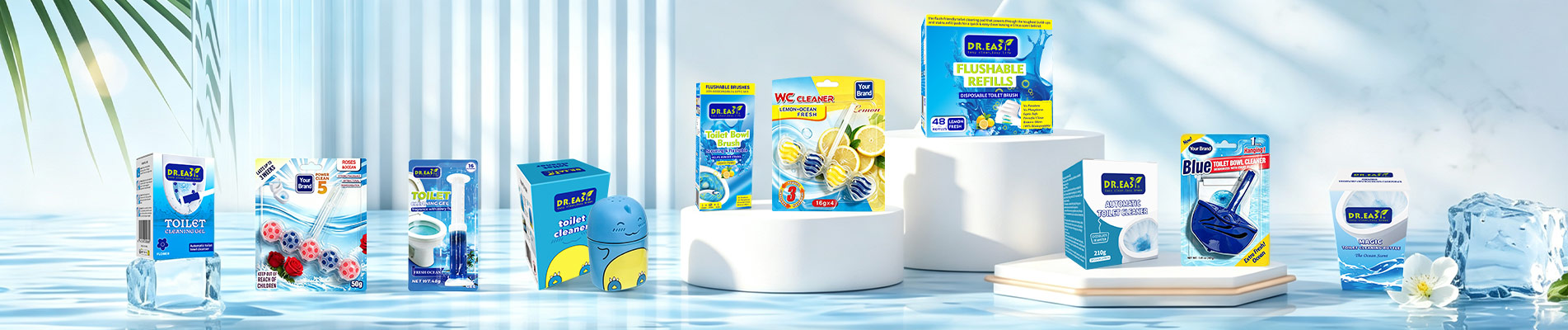
DR.EASY offers a range of toilet cleaning solutions for household, retail, wholesale, and private label applications.
3. Evaluate Packaging and Shipping Durability
Packaging is especially important when sourcing household chemical products for international markets. The packaging needs to protect the product during storage, handling, and transportation.
Depending on the product format, buyers should evaluate:
- Leak and spill resistance
- Cap and seal performance
- Packaging strength
- Product stability during transportation
- Carton efficiency
- Package size and shipping weight
For international B2B orders, packaging should be tested together with the actual product rather than evaluated only from a visual perspective.
4. Check Compliance and Import Documentation
Before placing a bulk order, buyers should confirm the regulatory and documentation requirements that apply to the product and destination market.
Depending on the product classification, destination country, and transportation method, buyers may need documents such as:
- SDS / MSDS: Safety information for applicable chemical products and transportation requirements.
- Ingredient or Product Information: Documentation required by the destination market or relevant authorities.
- Shipping Documents: Commercial invoices, packing lists, bills of lading, and other standard export documents as applicable.
- Regulatory Compliance: Confirm that the product and its ingredients meet the requirements of the target market.
It is better to confirm these requirements during the sourcing stage rather than discovering documentation problems after production has started.
5. Customization and OEM Support
For private label brands, sourcing is often more than simply purchasing an existing product. Buyers may need to customize the product to match their market positioning and brand requirements.
Depending on the product and project, customization may include:
- Formula: Adjustments based on required product performance and market requirements.
- Fragrance: Selection or development of fragrance profiles suitable for the target market.
- Product Format: Selection or development of a suitable product format.
- Packaging & Artwork: Private label packaging, labels, artwork, and packaging specifications.
- MOQ & Production: Order quantities, production planning, lead times, and re-order requirements.
A manufacturer with integrated OEM/ODM capabilities can help simplify communication between product development, packaging, production, quality control, and logistics.
Toilet Cleaning Product Format Comparison
| Product Format |
Main Function |
Typical Application |
Key Considerations |
| Rim-Mounted Products |
Cleaning and fragrance release |
Household and retail markets |
Release performance, packaging, product stability |
| In-Cistern Tablets |
Cleaning, freshening, or water treatment |
Household and retail applications |
Dosage, dissolution, performance consistency |
| Liquid Bowl Cleaners |
Direct toilet bowl cleaning |
Retail and commercial supply |
Formula performance, bottle design, leakage protection |
| Dosing Cleaning Gels |
Direct-to-bowl cleaning and freshening |
Retail and online channels |
Dosage, adhesion, fragrance release, packaging |
Note: Actual product performance and usage characteristics depend on the specific formulation, dosage, product design, water conditions, frequency of use, and other application factors. Buyers should confirm specifications and test samples before bulk production.
How to Choose a Toilet Cleaning Products Manufacturer
Choosing the right manufacturer is just as important as choosing the product itself. For B2B buyers, a supplier should be evaluated based on its ability to support both the initial project and long-term supply.
- Manufacturing Experience: Look for relevant experience in household cleaning and daily-use chemical products.
- Quality Control: Ask how raw materials, production processes, finished products, and batch consistency are managed.
- OEM/ODM Capability: Confirm whether the manufacturer can support formula, fragrance, product format, packaging, and branding customization.
- Production Capacity: Make sure the supplier can support your expected order volume and future re-orders.
- Communication: Clear communication during sampling, development, production, inspection, and shipment can help reduce sourcing risks.
Build Your Cleaning Product Line with DR.EASY
DR.EASY manufactures daily household cleaning products for global importers, distributors, wholesalers, and private label brands. Its product range includes toilet cleaning solutions as well as wet wipes, laundry care, air fresheners, and other household cleaning products.
For OEM and private label projects, DR.EASY supports product development, formula, fragrance, packaging, manufacturing, quality control, and logistics.
Not sure which toilet cleaning format is suitable for your target market? Discuss your product requirements with the DR.EASY team and explore suitable product, packaging, and customization options.
👉 Explore Custom OEM/ODM Solutions
Frequently Asked Questions (FAQ)
💬 Q1: Can we customize the fragrance and formula for private label orders? +
Depending on the product and project requirements, private label orders may support customization of formula, fragrance, product format, color, packaging, and branding.
💬 Q2: What documents may be required for importing toilet cleaning products? +
Documentation requirements vary by product classification, destination market, and transportation method. Depending on the project, buyers may need an SDS/MSDS, product or ingredient information, and standard export and shipping documents. Buyers should confirm specific requirements before shipment.
💬 Q3: How long does private label production take? +
Production timelines depend on the product, formula, packaging, order quantity, and customization requirements. Buyers should confirm sample development, artwork approval, production lead time, and shipping schedules with the manufacturer before placing an order.
💬 Q4: What information should I provide to get a quotation? +
Provide your target market, preferred product format, fragrance requirements, packaging preferences, estimated order quantity, private label requirements, and any specific compliance needs. The more detailed the requirements, the easier it is for the manufacturer to prepare a suitable quotation.







 IPv6 network supported