When choosing between laundry detergent sheets and liquid detergent, businesses need to look beyond the product format. For brands, importers, wholesalers, and distributors, the decision can affect packaging, storage, shipping arrangements, retail positioning, and total sourcing costs.
Each format has different product and packaging requirements. This guide explains the key differences, outlines the factors that influence purchasing decisions, and helps B2B buyers evaluate laundry detergent options for their target markets.
Quick Answer: Laundry Detergent Sheets or Liquid Detergent?
Laundry detergent sheets offer a compact, pre-portioned format, while liquid detergent is available in a range of formulations, bottle sizes, and refill packaging. Neither format is automatically better for every business. The right choice depends on cleaning performance, customer preferences, packaging requirements, distribution channels, and total landed cost. Buyers should compare product samples and supplier quotations against the same requirements before making a decision.
Key Takeaways
- Product format: Laundry detergent sheets and liquid detergent differ in dosing methods, packaging, storage, and handling.
- Cleaning performance: Formula composition, dosage, water temperature, and washing conditions matter more than format alone.
- Shipping costs: Compare actual packed dimensions, gross weight, carton configuration, order volume, and destination.
- Total sourcing cost: Include product pricing, customized packaging, testing, freight, and inventory requirements.
- Supplier selection: Confirm product specifications, sample results, MOQ, lead time, and available customization options before ordering.
1. Understanding Laundry Detergent Sheets and Liquid Detergent
Laundry Detergent Sheets
Laundry detergent sheets are thin detergent products designed to dissolve or disperse during a wash cycle. Their compact format and pre-portioned design make them an option for brands looking to offer an alternative to conventional liquid laundry detergent.
For private label projects, available specifications may include sheet dimensions, product weight, fragrance, packaging, and branding, depending on the manufacturer's capabilities. Buyers should confirm the recommended dosage, dissolution performance, storage conditions, and washing instructions for the specific product.
Packaging is an important consideration because detergent sheets may be sensitive to moisture. Buyers should assess the proposed packaging material, closure, and storage requirements to help maintain product quality throughout transportation and distribution.
Liquid Laundry Detergent
Liquid laundry detergent is a familiar format in many household laundry care markets. Depending on the product, it may be supplied in bottles, refill packs, or other containers suitable for liquid formulations.
Product specifications can vary by formula, concentration, fragrance, dosage, and container size. Buyers should review formula stability, container compatibility, closure performance, and leakage protection when evaluating a liquid detergent supplier.
Liquid detergent may be suitable for brands targeting consumers who prefer a familiar format or need multiple pack sizes. The final decision should take into account local market preferences, target pricing, retail requirements, and distribution arrangements.
2. Laundry Detergent Sheets vs. Liquid Detergent: Key Differences
The following table summarizes the main differences B2B buyers should consider. Actual performance, cost, and suitability depend on the product specifications, packaging design, order quantity, and supply arrangements.
| Comparison Factor |
Laundry Detergent Sheets |
Liquid Laundry Detergent |
| Product Format |
Thin sheets designed for use in measured portions |
Liquid formulation supplied in a suitable container |
| Dosing Method |
Based on the recommended number of sheets per wash |
Based on the recommended liquid volume per wash |
| Packaging Options |
Boxes, envelopes, pouches, or other suitable formats |
Bottles, refill packs, or other liquid-compatible containers |
| Storage Requirements |
Packaging and storage conditions should help protect against moisture |
Storage conditions and containers must be suitable for the formula |
| Shipping Considerations |
Evaluate packed dimensions, gross weight, and carton configuration |
Evaluate liquid weight, container dimensions, and leakage protection |
| Product Evaluation |
Check dissolution, dosage, washing results, and moisture protection |
Check formula stability, dosage, washing results, and container compatibility |
| Customization |
Potential options include sheet specifications, fragrance, and packaging, subject to supplier capabilities |
Potential options include formula, fragrance, concentration, and packaging, subject to supplier capabilities |
| Potential Market Fit |
Brands considering a compact, pre-portioned laundry care product |
Brands targeting customers familiar with liquid products or seeking varied pack sizes |
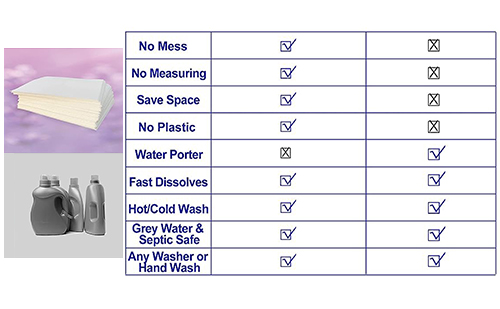
Comparison of laundry detergent sheets and liquid detergent formats, including dosing, packaging, storage, and shipping considerations.
Which Format Is More Cost-Effective to Ship?
Shipping costs depend on the finished product and how it is packed. Laundry detergent sheets may be supplied in compact packages, while liquid detergent requires containers suitable for liquid formulations and appropriate leakage protection. These differences can affect shipment planning, but they do not establish which format will always cost less to transport.
For an accurate comparison, ask suppliers to provide gross weight, carton dimensions, packing quantities, and freight estimates for the same order volume and delivery destination. Where relevant, compare pallet configuration and the transport method as well.
Which Format Offers Better Cleaning Performance?
Neither product format guarantees better cleaning results. Performance depends on factors such as formula composition, detergent dosage, water temperature, wash cycle, washing machine type, and the stains being treated.
Before approving a product, test samples under conditions representative of the intended market. Evaluate stain removal, dissolution or dispersion, fragrance after washing, and visible residue. Use consistent test conditions when comparing products, and agree on performance criteria with the supplier before finalizing the specification.
3. Which Laundry Detergent Format Fits Your Target Market?
For E-Commerce Brands
Laundry detergent sheets may be worth evaluating when compact packaging and pre-portioned use fit the brand's positioning. Buyers should assess packaging durability, moisture protection, product instructions, and fulfillment costs before launching the product.
Liquid detergent can also be suitable for online sales. Packaging strength, closure design, leakage prevention, and shipping arrangements should be reviewed as part of the product and fulfillment assessment.
For Supermarkets and Retail Chains
Retail buyers should consider shelf dimensions, packaging presentation, product information, price positioning, and local consumer preferences. Pack size and the number of washes stated on the label may also influence how shoppers compare products.
Detergent sheets can provide an additional format for brands looking to broaden a laundry care assortment, while liquid detergent may suit established product ranges and familiar usage habits. Market research and buyer feedback can help determine which format fits the intended retail channel.
For Wholesalers and Distributors
For wholesalers and distributors, the decision should account for more than the factory unit price. MOQ, carton configuration, shipping arrangements, product consistency, documentation, and replenishment lead times can all affect purchasing decisions.
Request quotations based on the same order quantity, packaging requirements, destination, and delivery terms. This makes it easier to compare suppliers and estimate the total cost of bringing each product to market.
4. How to Compare the Total Sourcing Cost
A lower quoted unit price does not necessarily mean a lower overall sourcing cost. When comparing laundry detergent products, buyers should consider the cost per wash alongside packaging, logistics, testing, and inventory requirements.
- Cost per wash: Compare the recommended dosage and stated number of washes using consistent assumptions. Pack prices alone do not provide a meaningful comparison.
- Product and packaging costs: Confirm the unit price, packaging materials, printing, labels, cartons, and any customized packaging charges.
- Freight and handling: Review gross weight, carton dimensions, pallet configuration where applicable, transport method, and delivery destination.
- MOQ and inventory: Check the minimum order quantity for the product and any separate minimums for customized packaging. Consider the inventory commitment required.
- Testing and documentation: Confirm which product tests, labeling reviews, and market-specific documents are required for the destination market.
- Lead time and replenishment: Clarify sample approval, production schedules, shipping arrangements, and expected repeat-order lead times.
For a reliable comparison, request quotations using the same product specifications, order quantities, packaging requirements, and delivery terms. Review the estimated total landed cost alongside product performance and target retail pricing before making a purchasing decision.
5. What Should B2B Buyers Check Before Choosing a Manufacturer?
Product Specifications and Sample Testing
Request samples and confirm the product specifications before placing a bulk order. For laundry detergent sheets, review sheet dimensions, product weight, recommended dosage, dissolution, and moisture sensitivity. For liquid detergent, review dosage instructions, viscosity where relevant, formula stability, and container compatibility.
Testing should reflect the product's intended use and target market. Any performance, safety, or environmental claims should be supported by appropriate evidence and documentation.
Private Label Packaging and Customization
Packaging affects product presentation, storage, transportation, and the customer experience. Ask whether the supplier can accommodate your preferred packaging format, branding artwork, product information, and applicable labeling requirements.
For international sales, check the labeling and documentation requirements for the destination market before approving the final artwork. Confirm the available customization options, associated costs, and any packaging minimums in writing.
MOQ, Pricing, and Production Lead Time
Request a quotation that clearly identifies product costs and any applicable sampling, packaging, printing, or development charges. The MOQ for the product may differ from the minimum order required for customized packaging.
Also clarify sample availability, approval procedures, production lead times, payment terms, and repeat-order arrangements. Confirm which details are included in the quotation so you can compare suppliers on a consistent basis.
Quality Control and Supplier Communication
Ask the manufacturer to explain its quality-control procedures and identify the relevant product documents it can provide. Discuss how product specifications are approved, how production batches are checked, and how changes to the formula or packaging are communicated.
Written specifications, agreed sample criteria, and clear communication help both parties establish expectations before production and manage consistency across repeat orders.
6. Private Label Laundry Care Solutions with DR.EASY
DR.EASY provides OEM, ODM, and private label manufacturing solutions for international B2B customers. Its Laundry Care range includes laundry detergent sheets, laundry detergent pods, dryer sheets, scent booster beads and crystals, bar soap, and other laundry care products.
For brands, importers, wholesalers, and distributors, a private label project may involve defining product specifications, selecting fragrance options, confirming packaging requirements, and preparing product artwork. Available options, minimum order quantities, and lead times depend on the selected product and project requirements.
When evaluating a laundry detergent manufacturer, buyers should define their target market, intended product format, estimated order quantity, packaging preferences, and performance requirements before requesting a quotation. Clear specifications help suppliers assess project requirements and provide more relevant pricing information.
Explore our Laundry Care products or learn more about our OEM, ODM, and private label custom solutions.
Frequently Asked Questions
Q1: Are laundry detergent sheets better than liquid detergent?
Neither format is automatically better for every business. The right choice depends on cleaning performance, customer preferences, packaging, distribution requirements, and total sourcing costs. Compare samples and supplier quotations against the same requirements before deciding.
Q2: Do laundry detergent sheets dissolve in cold water?
Dissolution depends on the product formula, water temperature, and washing conditions. Ask the manufacturer for product-specific instructions and test samples using the water temperatures and wash cycles relevant to your target market.
Q3: Are laundry detergent sheets cheaper to ship than liquid detergent?
Not necessarily. Shipping costs depend on packed dimensions, gross weight, carton configuration, order volume, destination, and transport method. Request comparable packing details and freight estimates for both formats before deciding which is more cost-effective.
Q4: Can I develop private label laundry detergent sheets?
Private label development may include product specifications, fragrance selection, packaging, and branding, depending on the manufacturer's capabilities. Confirm the available options, MOQ, sample procedures, and production lead time before placing an order.
Q5: What should I check before ordering from a laundry detergent manufacturer?
Review product specifications, sample test results, packaging options, MOQ, quotation details, quality-control procedures, applicable documentation, production lead time, and repeat-order arrangements. Make sure the agreed specifications and delivery terms are documented before production.
Q6: What information should I provide when requesting a private label quotation?
Provide your target market, preferred product format, estimated order quantity, packaging requirements, fragrance preferences, and any specific product or labeling requirements. If available, share your target price range and expected launch schedule. These details help the supplier assess the project and prepare a more relevant quotation.
Q7: Does DR.EASY provide OEM and ODM laundry care products?
DR.EASY provides OEM, ODM, and private label solutions across its Laundry Care product range. Customization options, minimum order quantities, and lead times depend on the selected product and packaging requirements. Contact the team with your project details to discuss suitable options.









 IPv6 network supported