Laundry scent booster beads give laundry care brands another way to expand their product ranges beyond detergent and fabric softener. For wholesalers, retailers, distributors, and private label businesses, choosing a manufacturer involves more than comparing fragrance options and unit prices.
Product specifications, packaging, minimum order quantities (MOQ), quality control, and target-market requirements all affect whether a project is commercially practical. This guide outlines the main points to review before selecting a laundry scent booster manufacturer.
Quick Answer: What Should You Look for in a Laundry Scent Booster Manufacturer?
Compare suppliers across product range, fragrance options, packaging, MOQ and pricing, quality control, and documentation. Give each supplier the same product brief so you can compare suitability and total project costs on a like-for-like basis.
Key Takeaways
- Confirm product specifications and available fragrances before requesting a quote.
- Evaluate samples under consistent conditions and document your approval.
- Discuss packaging, branding, MOQ, and extra costs early.
- Ask how approved specifications are checked during repeat production.
- Confirm labeling and documentation requirements for your target market.
1. Review the Manufacturer’s Product Range
Check that the supplier offers a product format suited to your market, price positioning, and sales channel. Compare net weight, existing specifications, fragrance choices, packaging formats, and available customization. If you plan to expand your laundry care range later, ask whether the supplier also works with related products such as detergent sheets or dryer sheets.
Browse DR.EASY’s scent booster beads and crystals to review the current product range. Confirm product-specific details with the supplier before making a purchasing decision.
2. Evaluate Fragrance Options and Sample Quality
Fragrance is central to the positioning of a private label laundry scent booster. Ask which scents are available as standard options and whether custom fragrance development can be considered. Do not assume every fragrance direction is available for every product.
Request samples when possible and assess them using consistent conditions. Consider the fragrance character before use, scent intensity during evaluation, the scent after washing and drying, and the overall product presentation. Compare samples using the same method, then confirm the approved product specifications in writing.
3. Check Private Label Packaging and Customization
Packaging affects shelf presentation, storage, shipping, and the customer experience. Ask about available formats and sizes, packaging materials, closure types, logo printing, label options, artwork preparation, printing costs, and lead times. Feasibility may depend on the product and order quantity, so confirm options before finalizing artwork.
Check that the product name, net weight, usage instructions, warnings, and other label details match the final product and applicable market requirements.
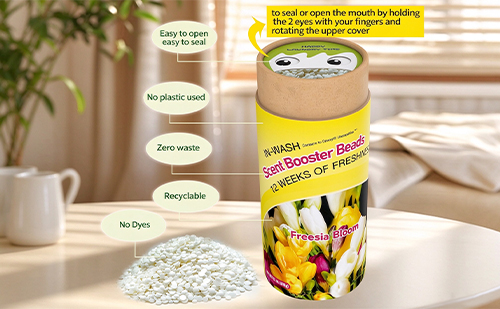
Example of laundry scent booster beads packaging with a twist-open lid.
Before publishing, verify any promotional claims visible in the image, including statements about plastic use, recyclability, dyes, waste, or fragrance duration. Use such claims only when they are supported for the specific product and packaging.
4. Understand MOQ and Quotation Requirements
MOQ and pricing can affect the feasibility of a new private label project. A lower MOQ does not necessarily mean a lower total cost, particularly when custom fragrance, packaging, or printing is involved. When requesting a quote, clarify the standard and customized MOQ, sample fees and shipping, packaging and printing costs, production lead time, and quotation terms such as EXW or FOB where applicable.
Send each supplier the same specifications and estimated quantity so the quotations are easier to compare. For DR.EASY products, confirm the MOQ and price for the selected product and customization requirements.
5. Assess Quality Control and Product Consistency
A sample that meets expectations is only a starting point. For repeat orders, ask how the manufacturer checks product and packaging specifications, references approved samples, handles non-conforming products, and documents quality concerns. Procedures differ by supplier, so ask about the checks relevant to your order rather than relying on general assurances.
Before production, confirm the approved sample, product specifications, artwork, order quantity, and acceptance requirements in writing.
Supplier Evaluation Checklist
| Evaluation Criteria |
Questions to Ask |
| Product specifications |
Can the supplier meet the required net weight and specifications? |
| Fragrance |
Are standard and custom fragrance options available? |
| Packaging |
Can the supplier support your preferred packaging and branding? |
| MOQ and pricing |
What are the minimum quantities and additional costs? |
| Quality control |
How are approved samples and production specifications checked? |
| Documentation |
What product information and documents can be provided for your market? |
6. Confirm Documentation for Your Target Market
Product documentation and labeling requirements can vary by destination market, formula, sales channel, and claims on the packaging. Tell the supplier where the product will be sold and ask which product information or documents can be provided. Verify applicable requirements independently before making compliance claims or approving final artwork.
7. Prepare a Product Brief Before Contacting a Supplier
A concise product brief helps suppliers understand your needs and provide a more relevant quotation. Include:
- Target country or region and sales channel
- Product concept, preferred fragrance, and target net weight
- Packaging format, branding, and artwork requirements
- Estimated initial order quantity and target timeline
- Known documentation or labeling requirements
If some details are undecided, share your target customers and product positioning first, then ask which options are feasible.
Laundry Scent Booster OEM/ODM Solutions with DR.EASY
DR.EASY provides OEM, ODM, and private label manufacturing support for household and laundry care products. Explore the scent booster beads and crystals range as a starting point, then confirm the available fragrance, net weight, MOQ, and packaging options for your selected product.
For tailored projects, DR.EASY’s Custom Solution service provides a way to discuss product development, formula support, fragrance, packaging, manufacturing, quality control, and logistics.
Planning a private label laundry scent booster? Contact DR.EASY with your product concept, target market, customization needs, and estimated order quantity.
Frequently Asked Questions
1. What is the typical MOQ for private label laundry scent booster beads?
MOQ depends on the product, packaging, and customization. Ask the supplier to confirm the minimum quantity for your chosen specifications.
2. Can I customize the fragrance?
This depends on the supplier’s capabilities and project requirements. Ask about standard scents, custom options, sampling, additional costs, and minimum quantities.
3. Can a manufacturer provide private label packaging and logo printing?
Many OEM/ODM suppliers offer packaging and branding options. Confirm available formats, printing methods, artwork requirements, costs, and minimum quantities.
4. Should I test samples before placing a bulk order?
Sample evaluation lets you review fragrance, specifications, and packaging before production. Record the approved details and communicate any changes in writing.
5. What information should I provide when requesting a quotation?
Share your target market, fragrance, net weight, packaging and branding needs, estimated quantity, timeline, and known documentation requirements.
6. What is the difference between OEM and ODM manufacturing?
OEM generally means manufacturing to the buyer’s specifications, while ODM may include more product development support. Confirm the exact scope, sampling responsibilities, packaging, and production arrangements with the supplier.









 IPv6 network supported